Friday, November 13, 2015

Will They or won't they?

The risks of the Federal Reserve moving too quickly or too slowly are nearly balanced, New York Fed President William Dudley said Thursday, pointing to a rate hike on the horizon.Dudley, a voting member of the Fed and vice chairman of the Federal Open Market Committee, emphasized, however, that a December liftoff depends on incoming data. Echoing comments from his colleagues, he said that the pace of tightening will be "quite gradual" once the Fed begins raising rates.The central banker said the strong October jobs report should "partially put to rest" concerns that the U.S. labor market might be faltering, adding that the country is much closer to maximum employment than it was at the start of the year.Some labor slack remains, Dudley said, explaining that he has still not seen compelling evidence that the tightening jobs market is leading to more rapid compensation gains.
Dudley also addressed earlier concerns that global economics could impact the Fed's decision, saying the international outlook appears less problematic than it did a few months ago.
On the inflation front, the New York Fed president said that, if the economy continues on its above-trend pace, then worries about low inflation should begin to recede. Core inflation, he added, should rise once transitory factors dissipate.
Dudley said he thought the fundamentals supporting U.S. domestic demand look "quite sturdy" and the housing fundamentals are solid. He did predict, however, that the trade sector will probably continue to drag on growth in 2016.
Chicago Fed President Charles Evans also spoke Thursday, saying the central bank is close to reaching its employment target, but it could be "well into" next year before the goal for inflation is reached to support a rate hike.
Once the Fed initiates liftoff, he said, an appropriate strategy would be to raise the target rate gradually.
Evans is a voting member of the FOMC, which meets next month to decide on whether to raise interest rates for the first time in nine years.
In remarks prepared for delivery to the Manufactured Housing Institute in Chicago, Evans said it could be well into next year before headwinds from lower energy prices and a stronger dollar dissipate enough to allow for sustained upward moment in core inflation.
"The outlook for inflation remains too low," he said. "A gradual path of normalization would balance both the various risks to my projections for the economy's most likely path and the costs that would be involved in mitigating those risks."
"It has been dumbfounding to me," Evans later reporters after his speech, of how little the inflation outlook has changed over the past several years, even as the U.S. economy has strengthened.
While Evans expects U.S. growth of about 2.5 percent in the next 1½ years, he said housing is one part of the economy that still has a good way to go. Progress in that area, he said, has been slow and uneven.
On the other side of the equation, St. Louis Fed President James Bullard said Thursday the Federal Reserve's unemployment andinflation goals have been met, and there is no reason to continue to "experiment" with policy extremes.
Bullard, in prepared remarks, said the near-zero interest-rate policy has put the U.S. economy at "considerable risk of future inflation."
Fed Chair Janet Yellen also spoke Thursday, although she did not comment on the outlook for the U.S. economy or her thoughts on monetary policy decisions.
Yellen, kicking off a research conference on policy transmission and implementation after the 2007-2009 financial crisis, said the central bank must weigh the effects of post-crisis financial regulations and new channels through which policy affects markets as it prepares to raise interest rates. She added that the Fed must also weigh the disadvantages of its actions in light of new tools meant to help the Fed raise rates.

                                   Comments by Nov. 20, 2015
Fed "policymakers should be mindful of new channels for monetary policy transmission that may have emerged from the intricate economic and financial linkages in our global economy that were revealed by the crisis," she said in prepared remarks.
"It is crucial to understand the effect of regulations and possible changes in financial intermediation on monetary policy implementation and transmission," Yellen added.
Richmond Fed President Jeffrey Lacker also spoke Thursday, saying he continues to hold the view that monetary policy has the unique ability to determine inflation over time. Still, he said, caution should apply to the notion that policy should respond to signals of incipient financial instability.
Monetary policy's ability to affect real economic activity can be quite limited and is almost always short-lived when well-executed, he said.
The rate hike has been stymied in part by low inflation that continues to run below the Fed's 2 percent target rate, and some policymakers have advocated waiting for more signs that inflation will rise before embarking on a path of monetary tightening.
Lacker, who has twice voted this year to raise rates when the rest of his colleagues decided to stay put, said the recent behavior of inflation "does not warrant such pessimism." But he added that the credibility of such an inflation goal "depends on the public's belief that the central bank has and will use the tools necessary to make inflation return to its goal, should that become necessary."  (Reuters)

Friday, November 6, 2015

How to Fix the American Economy

                        
                                                           Comments due Nov. 13, 2015

In his new book, a Nobel laureate outlines how the huge disparity arose and the huge course correction needed to address it.  Stiglitz, a Nobel-prize winning economist, professor at Columbia University, and the chief economist at the Roosevelt Institute, asks the question “Can the rules of America’s economy be rewritten to benefit everyone—not just the wealthy?” The answer, he insists, is yes. Stiglitz describes the current situation as “ a stark picture of a world gone wrong” : He notes that 91 percent of all income growth between 2009 and 2012 was enjoyed by the wealthiest 1 percent of Americans. In the first half of the book, Stiglitz focuses on the practices and policies that have gotten the country to this point. It is a familiar story: The demise of labor unions, the increasing financialization of the economy, and the lack of wealth-building opportunities in minority communities have made the rich richer while leaving everyone else to flounder. He lists off a bevy of other contributors too: weak wages, ineffective regulation and federal oversight, and a focus on short-term versus long-term growth, which embodies a preference for rewarding shareholders over workers and consumers. Stiglitz also notes that despite advancements in technology, which should— in theory—increase efficiency and lower costs, consumers are paying more in fees for financial services, which enriches big banks and companies while siphoning money out of the middle class. All of these things, he says, have created a society with a gaping hole, not only in its economic makeup, but in its morality.

Stiglitz spends the latter portion of the book laying out how to fix things. Like his primer on how inequality came to be, the solutions cover everything from fiscal policy to corporate boardrooms to retirement savings. His overview doesn’t prioritize pragmatism: A solution that only involves overhauling the few things that everyone agrees need to be overhauled is no solution at all, he argues. Instead, he swings for the fences, suggesting a massive revision in the way the U.S. economy does business. First up is the attempt to tame what is called rent-seeking—the practice of increasing wealth by taking it from others rather than generating any actual economic activity. Lobbying, for example, allows large companies to spend money influencing laws and regulations in their favor, but lobbying itself isn’t helpful for the economy besides creating a small number of jobs in Washington; it produces nothing but helps an already rich and influential group grow more rich and more influential. Stiglitz suggests that reducing rent-seeking is critical to reining in inequality, especially when it comes to complex issues such as housing prices, patents, and the power that large corporations wield. To overhaul these behaviors and the policies that support it, Stiglitz says that America should give up what he deems the “incorrect and outdated” belief in supply-side economics, which grows from the premise that regulation and taxes dampen business opportunities and economic growth. Instead, massive changes to tax laws, regulations, and the financial sector are needed, he says, in order to curb rent-seeking. For instance, increasing tax rates, ending preferential treatment for top earners, and refining the tax code would decrease incentives to amass extreme amounts of wealth, since it would be so heavily taxed, and that tax would be difficult to shirk. Stiglitz suggests a 5 percent increase to the tax rate of the top 1 percent of earners—a move that he says would raise as much as $1.5 trillion over 10 years. He also calls for a “fair tax, ” which would eliminate preferential tax treatment for money earned from capital gains and dividends—perks enjoyed primarily by people who can afford to own a lot of stock. To further ensure that corporations, markets, and individuals aren’t pursuing profits at the expense of workers and the public, Stiglitz calls for a more active central bank. He accuses the Fed of being both too narrowly focused on macroeconomic indicators, and too deferential to the businesses and markets it has the ability to regulate. He wants the government to sponsor a homeownership agency that would dole out housing loans in a way that encourages buyers instead of developers and would closely monitor the market for fairness. Stiglitz ’s thoroughness is admirable, but his prescriptions can be overwhelming, given how much it would take to make each change. The agenda also includes emphasizing the goal of full employment rather than focusing on the sometimes reductive unemployment figures; investment in public infrastructure; better access to financial services, childcare, health care, and paid leave; and strengthened opportunities for collective bargaining. Oh, and better wages for workers, and more corporate transparency, too. Actually implementing all of these changes would require a complete shift in American policy and practice. The world that Stiglitz envisions in his book, one where all citizens can enjoy the promise of education, employment, housing, and a secure retirement seems at once like the realization of the American dream and an unattainable utopia.

Friday, October 30, 2015

Is The US Economy in Trouble ?


                                                         Comments due by Nov. 6, 2015

I write about economics for a living. Part of my job is to look into the maw of economic data, financial market indicators, anecdotal reports from businesses and whatever else I can get my hands on, and turn it all into a crisp, clear narrative about the United States and global economies.
 But right now I’m stuck. I have no idea how the United States economy is doing. And the closer I look at the data, the more contradictory it looks. A strong case could be made that it is in its most vulnerable spot in years, at risk of a new recession amid a global slowdown. The market for many types of risky bonds is in disarray, and “the dangers facing the global economy are more severe than at any time since the Lehman Brothers bankruptcy in 2008,” wrote Larry Summers in a NYT article. There is also a strong case that the United States economy is robust enough to withstand whatever challenges might arise from overseas, and that the evidence of a slowdown is scattered and overstated. Fewer people have filed for unemployment insurance in recent weekly readings, for example, than any time since 1973. I’ve tried several times in the last few weeks to convince myself that one of those stories is correct, but just can’t decide between them. And because The New York Times is not fond of headlines that include the “shruggie” emoticon (for the uninitiated, that would be ¯\_(ツ)_/¯), I have held off writing anything. Why am I telling you all this? Because sometimes the most accurate portrayal of a situation revolves around uncertainty — and because we journalists aren’t always honest about that. This is my effort to be a little more honest. Rather than picking an analytical case and pretending to be more certain than I am, I want to walk readers through the conflicting evidence. Below, I do so in the form of the debate that has been playing out within my own head — and, very likely around conference tables at every economic research group and central bank you can think of. It sure feels as if we’re on the verge of something bad. The expansion is six years old, making it already the fourth longest since World War II. If the economy does soften, the Federal Reserve is out of ammunition to do much of anything about it. This feels a little like late 2000, when there were signs the economy was losing momentum even though growth was still technically positive. Then in 2001 there was a mild recession. Whoa, not so fast. Back then there was a huge correction in the stock market and downturn in business investment that caused the recession.
What are the sectors that you see correcting in 2015 or 2016 that put the economy at that much risk? Emerging markets, especially China? They’ve had years of huge capital inflows, in no small part because of Fed policies, that papered over longer­term problems. Now the capital is flowing in the other direction, and the correction is looking to be vicious. Sure, but why would that cause anything more than modest ripples for the United States economy? Total exports to China were $124 billion last year, about 0.7 percent of United States G.D.P. And I know you’re going to mention financial linkages, but it’s not as if American banks are sitting on a ton of Chinese government debt. Even if things get worse in emerging markets, isn’t this more like 1998, when an emerging markets crisis enveloped East Asia and Russia? As a reminder, the United States economy grew 4.7 percent in 1999, faster than in the preceding 15 years. Yeah, but there’s no doubt that the financial markets, including in the United States, have been flashing warning signs since this summer. Sure, markets have been jumpy lately. But when you step back and take a bit of a long view, is it really anything to sweat about? The Standard & Poor’s 500­stock index was actually up very slightly for the year at Monday’s close (up 0.6 percent, to be precise). Long­term Treasury bond rates have fallen a good bit since the summer but are still higher than they were back in the spring, meaning that the bond market isn’t exactly panicking. Maybe Wall Street is just whining because after five years in which asset prices soared much more than the real economy, markets are taking a breather while the rest of the economy catches up? Maybe, but there are some cracks showing in the data on the real economy too. The last couple of jobs reports have been really bad! This month the data on retail sales and surveys of businesses have shown the same kind of softness. Maybe the economy is like Wile E. Coyote  running off the cliff , and as soon as we look down we’ll see it was all a mirage and fall. Come on, that’s not how the economy works. For the economy to fall into recession, something has to cause it.

A financial crisis that freezes up the credit system, tight monetary policy intended to fend off inflation, a collapse in the stock market, something. Recessions don’t just happen for no particular reason. It’s true that the economy is starting to feel an impact of the strong dollar (resulting in weaker exports) and cheaper oil (which means less oil and gas exploration). But we’ve seen soft patches like this many times before. For example, job growth has been really weak the last couple of months, but it was about equally weak in June and July of 2013, and nobody even remembers that soft patch. And if you look at the broadest measures of the economy, there’s not much sign of a downturn at all. For example, over the first nine months of 2015, United States gross domestic product rose at about a 2 percent annual rate, including a 1.5 percent third­quarter pace reported Thursday, broadly similar to the last several years. This could just be a case where people are freaked out by the market moves and are straining to discern a downshift in the economy that isn’t really there. Yeah, but look at all the anxiety we’re hearing this earnings season. Big, stalwart companies like Caterpillar and Walmart have downgraded their forecasts. Surely those are the canaries in the recessionary coal mine. There you go with the clichés again. When you look a little more closely at some of these disappointing forecasts, what they’re really telling us about the state of the economy is far more ambiguous. Take Caterpillar. Yes, it slashed its revenue forecast for 2015 and said it would cut 10,000 jobs in the next three years. But the major reason is the downturn in mining and energy exploration because of cheaper oil and other commodities. Obviously, it’s too bad for those people who will lose their jobs, but the flip side is cheaper gasoline and other fuels for American consumers, which is an economic boost. The story out of Walmart is even more promising for the economy. Sure, the company’s stock dropped 10 percent in a single day two weeks ago as it downgraded its earnings projections. But look at why it downgraded those projections — because it is investing more to upgrade its stores, and paying its workers more, both of which will weigh on profits. We’ve had years in which the problem in the economy has been companies that won’t invest and workers who aren’t getting pay raises. Walmart’s earnings are suffering because of the opposite! That’s good news for the economy, even if it’s bad news for Walmart shareholders. O.K., Pollyanna, anything out there that does make you nervous? Oh, sure. The drop in stock prices and rise in borrowing costs for riskier companies means that capital is more expensive, and the dollar keeps strengthening on currency markets that will keep holding things back. And if I’m wrong about any of this, the economy really does lack the shock absorbers right now that would help it: The Fed’s most effective tools are pretty well spent, and there’s no way a Republican Congress would even consider fiscal stimulus. So I get being nervous, but this doesn’t feel like a moment when there are huge imbalances sitting out there due for a correction. I hope you’re right. But if the 2008 crisis taught us anything, it’s that trouble can spread in ways that are hard to predict, even if you think you know what’s going on. Yeah, but what happened in 2008 was a once ­a ­century kind of storm. If you always think that the big one is imminent, most of the time you’ll turn out to be wrong. (The Upshot NYT 10/29/2015)

Friday, October 23, 2015

Why Negative Interest Rates?

                                          Comments due by Oct. 30, 2015 

When the Federal Open Market Committee decided in September to leave its main policy rate where it’s been for seven years—close to zero—it included an extraordinary detail. According to the “dot plot,” the display of unattributed individual policy recommendations, one committee member believed that the rate should be below zero through 2016. That is, rates should go to a place the U.S. has never had them before.
In theory, it shouldn’t be possible for a central bank to keep short-term interest rates below zero. Banks would have to pay the Federal Reserve to hold reserves. Consumers would have to pay banks to hold deposits. Banks and people can hold physical cash, which charges no interest. This is why economists see zero as the lowest possible rate. It’s just theory, though; real-world experience shows the actual lower bound is somewhere below zero.


Denmark’s key bank rate dipped below zero in 2012 and is at minus 0.75 percent. Economists recently surveyed by Bloomberg see negative rates in that country continuing at least into 2017. Switzerland has kept the rate at minus 0.75 percent since early this year, and Sweden’s is minus 0.35 percent. These countries have a different monetary goal from that of the Fed. Denmark and Switzerland have been working to remove incentives for foreigners to deposit money in their banks. Massive foreign inflows would drive their currencies to appreciate so much they would become seriously misaligned with the euro, the currency of their main trading partners. Sweden has been attempting to create inflation.
The strategy has had some success. Denmark has been able to hold on to its peg to the euro. Switzerland dropped its euro peg, and after an initial runup, the Swiss franc has traded within a predictable band. Sweden’s inflation has seesawed.
In all three countries, banks were reluctant to pass negative rates on to their domestic customers. In Denmark deposit rates have fallen, and some banks have raised fees for their services, but “real rates for real people were actually never negative,” says Jesper Rangvid, a professor of finance at the Copenhagen Business School. The same is true for Sweden, according to a paper by the Riksbank, the central bank. In Switzerland, one bank, the Alternative Bank Schweiz, will impose an interest charge on retail deposits starting in January.
There’s no evidence of a flight to cash in any of the three countries. According to central bank data, Danish households have added 28 billion kroner ($4.3 billion) to bank deposits since rates shrank to their record low on Feb. 5. That’s because a sack of bills has to be stashed somewhere safe, and protection costs money. According to Rangvid, rates would have to drop as low as minus 10 percent before people start “building their own vaults.” In its paper, Sweden’s Riksbank pointed out the same possibility but declined to say how far below zero rates would have to go to trigger depositors’ exit from the banks in the largely cash-free country.
In the U.S., Narayana Kocherlakota, the dovish president of the Minneapolis Fed, has expressed support for negative rates as an option. (He’s likely the anonymous negative rate dot-plot guy.) So has John Williams of the San Francisco Fed. William Dudley of the New York Fed, a moderate, said during an Oct. 15 event that the FOMC had considered negative rates during the depths of the financial crisis. Experience in Europe, he said, showed that the unintended consequences of negative rates were “less than what people had feared.”
Since they dropped rates below zero, there has been no clear, consistent economic trend among the three countries. In Denmark asset prices have risen as Danes sought higher returns. Spurred by speculation, the local stock market has recorded more than twice the gains of the Stoxx Europe 600. Danske Bank, Denmark’s biggest lender, says Copenhagen is becoming Scandinavia’s riskiest property market, because of a surge in prices. Danish businesses have increased their investments only 6 percent; private consumption has risen 5 percent. According to Torsten Slok, Deutsche Bank’s chief international economist in New York and a Dane, negative rates “raise risks in the short term and do little more to help the economy than what can be achieved with bond purchases.”
In Switzerland there’s little sign of overheated property or stocks, or new consumption. Recently, Thomas Jordan, head of the Swiss National Bank, saw potential side effects but called negative rates an “important and unavoidable monetary instrument to weaken the attractiveness of the [Swiss] franc.”
All three countries have dipped below zero without massive withdrawals. That’s a valuable lesson for economists. But in Sweden, it’s too early to tell whether negative rates have created inflation. And in Denmark and Switzerland, this tool has succeeded only in its precise and limited purpose: to manage exchange rates with the euro. That finding will be of limited value to the Fed.
—With Peter Levring, Nick Rigillo, and Catherine Bosley

Friday, October 16, 2015

Is family paid leave inevitable?

479631115

                                                           Comment due by Oct. 23, 2015

Presidential candidates are talking about paid family leave — both for and against it — because they know this issue is top of mind for voters throughout the country. For American voters, family comes first. Whether it's for a newborn, an ailing parent, or a spouse nursing an injury, being there and providing for family isn't negotiable.
The question is whether we as a nation are going to let every family fend for themselves, or adopt a national solution that makes sure that putting family first doesn't mean losing your paycheck or your job. Voters are demanding policies that reflect this priority. 
"It's about time we had paid family leave for American families and join the rest of the world," said Secretary of State Hillary Clinton in her opening remarks at the first Democratic debate.
Vermont Senator Bernie Sanders echoed: "We should not be the only major country that does not provide medical and — and parental leave — family and parental leave to all of our families."
Former Maryland Gov. Martin O'Malley built on the idea: "We would be a stronger nation economically if we had paid family leave."
The three Democratic front-runners are not the only ones speaking to this issue. Florida Sen. Marco Rubio, who's running in the Republican primary, has come out with his own paid family-leave proposal (albeit a severely flawed one), and former Hewlett-Packard CEO Carly Fiorinadevoted an entire blog post to defending her position against paid family leave.
Recent polling by "Make it Work," a campaign I co-founded to advance women and working families' economic issues, found that 75 percent of voters say they support a package of work-family policies that includes paid family leave, paid sick days, equal pay, affordable child care and a higher minimum wage. Fifty-six percent of voters said they are more likely to vote for a candidate who supports this plan.
And it's not just women. Fifty-five percent of men say they are more likely to vote for candidates who support this plan. The number of men who use the job protections of the current Family and Medical Leave Act to care for family members has been slowly but steadily increasing, and more and more men are calling for employers to adopt paid parental leave policies.
Paid family leave and other family-friendly policies are good for children, good for families, good for public health and, as Gov. O'Malley noted, good for the economy. In the states that have adopted paid leave – California, New Jersey and Rhode Island – both employers and employees report benefiting from the law. And in recent months, we've heard from companies like NetflixMicrosoftAdobeLinkedIn,FacebookGoogle and others about their recently adopted generous paid leave policies for moms and dads. These policies aren't always perfect, but the idea that companies should be providing these supports for families – from 12 weeks to 52 weeks of fully paid leave – comes from the understanding that these policies are not only the right thing to do, but also good for business and retaining great employees.
We can't rely on companies to do it alone, or too many people will be left behind – especially low-income families who need paid leave the most. That's why presidential candidates are taking the matter into their hands. In the Democratic debate, Sec. Clinton pointed to Sen. Kirsten Gillibrand (D-NY) as a champion of this issue. The Family Act, the bill championed by Gillibrand and Rep. Rosa DeLauro (D-Conn.), would guarantee paid leave to care for new children and those with serious illnesses. With the right candidate, paid family and medical leave could finally become a reality in 2017. 
Commentary by Vivien Labaton, co-founder and co-director of MakeIt Work

Friday, October 9, 2015

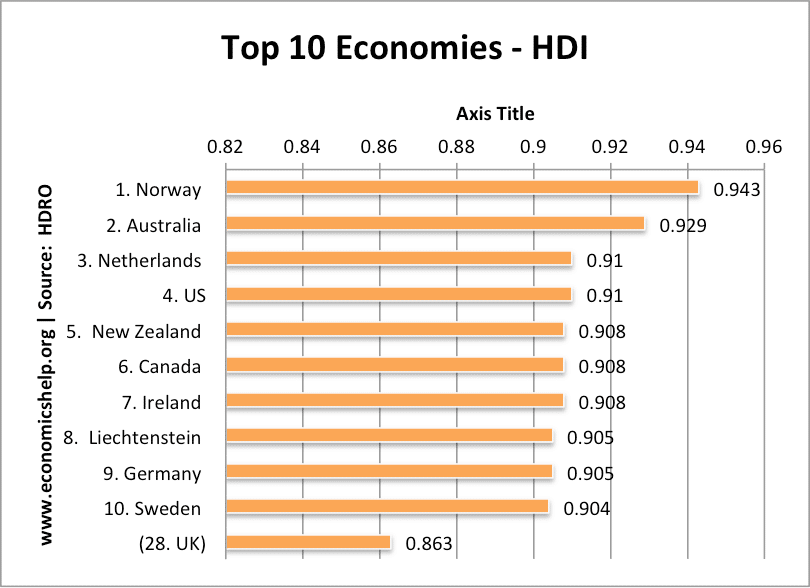
Human Development Index


                                                      Comments due by Oct. 16, 2015
The HDI was created to emphasize that people and their capabilities should be the ultimate criteria for assessing the development of a country, not economic growth alone. The HDI can also be used to question national policy choices, asking how two countries with the same level of GNI per capita can end up with different human development outcomes. These contrasts can stimulate debate about government policy priorities.
The Human Development Index (HDI) is a summary measure of average achievement in key dimensions of human development: a long and healthy life, being knowledgeable and have a decent standard of living. The HDI is the geometric mean of normalized indices for each of the three dimensions.
The health dimension is assessed by life expectancy at birth component of the HDI is calculated using a minimum value of 20 years and maximum value of 85 years. The education component of the HDI is measured by mean of years of schooling for adults aged 25 years and expected years of schooling for children of school entering age. Mean years of schooling is estimated by UNESCO Institute for Statistics based on educational attainment data from censuses and surveys available in its database. Expected years of schooling estimates are based on enrolment by age at all levels of education. This indicator is produced by UNESCO Institute for Statistics. Expected years of schooling is capped at 18 years. The indicators are normalized using a minimum value of zero and maximum aspirational values of 15 and 18 years respectively. The two indices are combined into an education index using arithmetic mean.
The standard of living dimension is measured by gross national income per capita. The goalpost for minimum income is $100 (PPP) and the maximum is $75,000 (PPP). The minimum value for GNI per capita, set at $100, is justified by the considerable amount of unmeasured subsistence and nonmarket production in economies close to the minimum that is not captured in the official data. The HDI uses the logarithm of income, to reflect the diminishing importance of income with increasing GNI. The scores for the three HDI dimension indices are then aggregated into a composite index using geometric mean. Refer to Technical notes for more details.
The HDI does not reflect on inequalities, poverty, human security, empowerment, etc. The HDRO offers the other composite indices as broader proxy on some of the key issues of human development, inequality, gender disparity and human poverty.
A fuller picture of a country's level of human development requires analysis of other indicators and information presented in the statistical annex of the report.

Copy this link into your browser to look at the HDI data:
http://hdr.undp.org/en/content/table-1-human-development-index-and-its-components

Friday, October 2, 2015

OPEC's Family Feud

                                                   Comments due by Oct 9, 2015

When Venezuelan Oil Minister Juan Pablo Pérez Alfonso resigned in 1963, he blasted the Organization of Petroleum Exporting Countries, at the time torn by internal rivalries, for failing to produce any benefits for his country. Half a century later, OPEC is still split and Venezuela is again unhappy, this time at the unwillingness of the organization’s top producer, Saudi Arabia, to rescue oil prices from a six-year low that’s dragging the battered Venezuelan economy into an even deeper crisis.
On Sept. 10, Venezuela’s oil minister, Eulogio del Pino, tweeted appeals for OPEC and non-OPEC countries “to have a discussion on fair prices, minimum prices to ensure sustainability” and to “overcome our differences of opinion.” Venezuelan President Nicolás Maduro said on Sept. 16 that he was making progress on organizing a summit of petroleum exporting countries to have that discussion. OPEC member Algeria is backing the Venezuela-proposed conference—as well as Maduro’s desire for a higher price. Venezuelan officials didn’t respond to requests for comment.
Maduro’s plans won’t pan out unless Saudi Arabia stops flooding the market. There’s no sign it’ll retreat from that strategy, which is helping it preserve and even gain market share. “OPEC is of no use today,” says former Algerian Prime Minister Ahmed Benbitour. “The war now is about market share, not price, and Algeria is getting no benefit from this organization.” OPEC declined to comment for this story.
Venezuela’s and Algeria’s complaints raise the question of why some members stay in OPEC if the Saudis call the shots and ignore pleas for higher prices. Neither Venezuela nor Algeria has made moves to quit. Not only is the group intact, but former member Indonesia is returning, boosting membership to 13 nations.
Disgruntled members “don’t leave because they still believe there could be something in the future where the group does make a decision” to boost prices and cut production, says Jamie Webster, an oil analyst at researcher IHS. “It’s much easier to just keep OPEC alive than to shut it down, and with it a key communication channel” among governments whose financial health depends largely on oil income.
Of the 1.7 trillion barrels that remain to be extracted worldwide, 1.2 trillion, or 70 percent, are controlled by OPEC’s current members. Venezuela and Saudi Arabia hold 18 percent and 16 percent, respectively, and Iran and Iraq 9 percent each, according to oil major BP. These four nations, with Kuwait, are OPEC’s founding members.


“Just look at the outlook for oil in the next 10, 20, 30 years. It is expected that OPEC countries will actually have to come up with most of the growth in supply to meet the demand,” says former OPEC Secretary General Adnan Shihab-Eldin of Kuwait. “If OPEC didn’t exist, it would be needed in the future much more than in the present or the past” to coordinate production and keep the world supplied.
Pricing has often been a bone of contention, with Algeria, Iran, Iraq, Libya, and Venezuela pushing for higher prices, a hawkish stand compared with Saudi Arabia and its neighbors Kuwait, Qatar, and the United Arab Emirates. “Venezuela’s position within OPEC is to pursue a strategy of low production and high prices, since they can’t attract investments” to boost output, says Carlos Rossi, president of Caracas-based consulting firm EnergyNomics. Gulf Arabs are more inclined to accept a lower price to keep consumers hooked on cheap gasoline and thus extend the Age of Oil. Saudi Arabia in particular is more likely to accept a lower price that preserves global growth and gives it influence far in excess of its actual economy. Says Ed Morse, Citigroup Global Markets managing director: “Saudi Arabia’s economy is the size of Illinois’s.” Yet the nation sits at the same table as China, Europe, Japan, and the U.S. thanks to its role as the major producer.
Instead of lowering output to prop up prices, as suggested by Algeria and Venezuela, Saudi Oil Minister Ali al-Naimi lobbied his OPEC counterparts in November 2014 not to yield market share to competing suppliers, including U.S. producers of shale oil. Crude sank and trades at about $50 a barrel, half its level a year ago. “What OPEC wanted to do is have a fresh look at the structural changes that have taken place in the oil market with the advent of U.S. shale and other producers, who at a very high price were able to bring in fresh supplies that far exceed what demand called for,” says Shihab-Eldin.
Algeria’s and Venezuela’s attempts to recruit non-OPEC producers in an effort to increase prices have been rejected by Russia and Mexico, two of the largest exporters outside the group. The Mexicans say their focus is on restoring the productivity of their biggest field. Russia says it doesn’t have the ability of some Persian Gulf producers to quickly raise or lower output because of the harsh winters and complex geology at its Siberian oil fields. “You cannot regulate productivity of Russian wells simply by turning a faucet,” Sergei Klubkov, exploration and production analyst at Moscow-based Vygon Consulting, said in an e-mail.
The International Energy Agency says Saudi Arabia is winning the fight for market share, driving higher-cost producers—for example, some U.S. shale companies—out of business. Non-OPEC supply is expected to fall in 2016 by the most in more than two decades as producers shut wells that can’t operate profitably with oil below $50 a barrel. Production outside OPEC will fall by 500,000 barrels a day, to 57.7 million, in 2016, the agency said on Sept. 11.
That’s no solace for those in OPEC who are hard-pressed for cash. Fresh supply is likely to hit the market from Iran next year, when the oil export ban is lifted as a result of the July agreement with the U.S. and the other Western powers restricting its nuclear program. Oil prices could drop to as low as $20 a barrel, Goldman Sachs said on Sept. 11.
Saudi Arabia’s production of about 10.5 million barrels a day is its highest ever, and the kingdom still has spare capacity of more than a million barrels. Other OPEC members are pumping less oil as projects to bring fresh crude to the market were derailed or delayed by political or social unrest. Venezuela is producing 2.5 million barrels a day, vs. a peak of 3.7 million in 1970. Algeria and Nigeria are in similar straits.
Those three nations, plus Iraq and Libya, are the OPEC members most vulnerable to political turmoil as cheap oil hammers their currencies and weakens their ability to sustain social subsidies. Venezuela “appears poised for a near-term crisis” amid protests and shortages of basic goods as December’s parliamentary elections get closer, analysts Christopher Louney and Helima Croft of the Royal Bank of Canada said in an August report on OPEC’s “fragile five.”
“OPEC is like a family where the children quarrel but can’t do without each other,” says Karin Kneissl, a Vienna-based university lecturer on energy politics and author ofEnergy Poker. “They know they are better off talking to each other to preserve the common, long-term interest; even those who left long to return if they can.”
Indonesia voluntarily suspended its OPEC membership in 2009 as its production declined to the point that it had to import oil. Indonesia still pumps oil for its domestic market. It will return officially on Dec. 4 as the first member that isn’t a net oil exporter. As OPEC’s only member in East Asia, Indonesia could help strengthen the group’s ties in the region, where oil demand is strongest, said Indonesian Energy Minister Sudirman Said in June. As both oil consumer and producer, it will help OPEC bridge the divide between the two groups, he said.
“The benefits from staying with the group outweigh by far the cost of membership,” says Hasan Qabazard, chief executive officer of Kuwait Catalyst and former head of research at OPEC. “Getting firsthand access to market data, research, and information that may affect the market” could be “the motivation behind Indonesia’s application” to return.
“I don’t see OPEC falling apart,” says Fayyad Al-Nima, Iraq’s deputy oil minister for extraction. And Venezuela’s reason for sticking with the group? Says Carl Larry, head of oil and gas for market researcher Frost & Sullivan: “It’s either stay with OPEC and tag along or leave OPEC and be by yourself.”
The bottom line: Saudi Arabia manages to impose its will on other members of OPEC, thanks to its ability to flood the market.

Friday, September 25, 2015

VW Scandal and the German Economy

                                                    Comments due by Oct. 2, 2015

The Volkswagen (VOWG_p.DE) emissions scandal has rocked Germany's business and political establishment and analysts warn the crisis at the car maker could develop into the biggest threat to Europe's largest economy.
Volkswagen is the biggest of Germany's car makers and one of the country's largest employers, with more than 270,000 jobs in its home country and even more working for suppliers.
Volkswagen Chief Executive Martin Winterkorn paid the price for the scandal over rigged emissions tests when he resigned on Wednesday and economists are now assessing its impact on a previously healthy economy.
"All of a sudden, Volkswagen has become a bigger downside risk for the German economy than the Greek debt crisis," ING chief economist Carsten Brzeski told Reuters.
"If Volkswagen's sales were to plunge in North America in the coming months, this would not only have an impact on the company, but on the German economy as a whole," he added.
Volkswagen sold nearly 600,000 cars in the United States last year, around 6 percent of its 9.5 million global sales.
The U.S. Environmental Protection Agency said the company could face penalties of up to $18 billion, more than its entire operating profit for last year.
Although such a fine would be more than covered by the 21 billion euros ($24 billion) the company now holds in cash, the scandal has raised fears of major job cuts.
The broader concern for the German government is that other car makers such as Daimler (DAIGn.DE) and BMW (BMWG.DE) could suffer fallout from the Volkswagen disaster. There is no indication of wrongdoing on the part of either company and some analysts said the wider impact would be limited.
The German government said on Wednesday that the auto industry would remain an "important pillar" for the economy despite the deepening crisis surrounding Volkswagen.
"It is a highly innovative and very successful industry for Germany, with lots of jobs," a spokeswoman for the economy ministry said.

But analysts warn that it is exactly this dependency on the automobile sector that could become a threat to an economy forecast to grow at 1.8 percent this year. Germany is already having to face up to the slowdown in the Chinese economy.
"Should automobile sales go down, this could also hit suppliers and with them the whole economy," industry expert Martin Gornig from the Berlin-based DIW think tank told Reuters.
In 2014, roughly 775,000 people worked in the German automobile sector. This is nearly two percent of the whole workforce.
In addition, automobiles and car parts are Germany's most successful export -- the sector sold goods worth more than 200 billion euros ($225 billion) to customers abroad in 2014, accounting for nearly a fifth of total German exports.
"That's why this scandal is not a trifle. The German economy has been hit at its core," said Michael Huether, head of Germany's IW economic institute.


"MADE IN GERMANY"
There are also voices, however, that say the impact on the economy as a whole should not be exaggerated.
"I don't think that the German automobile industry will be lumped altogether," Commerzbank chief economist Joerg Kraemer told Reuters.
"There won't be a recession just because of a single company," Kraemer added.
The German BGA trade association also tried to calm the public by saying there were no signs that customers abroad were starting to doubt quality and reliability of German companies.

"There isn't a general suspicion against goods labeled 'Made in Germany'," BGA managing director Andre Schwarz told Reuters.
But he acknowledges there is a degree of concern among German companies that the scandal over cheating on U.S. diesel emission could have a domino effect on their businesses, eroding the cherished 'Made in Germany' label.
Some observers also see some irony in the scandal.
While the German economy defied the euro zone debt crisis and, so far, the economic slowdown in China, it could now be facing the biggest downside risk in a long while from one of its companies.
"The irony of all of this is that the threat could now come from the inside, rather than from the outside," Brzeski said. (Reuters)

Thursday, September 17, 2015

FRAUD, FOOLS & the FINANCIAL MARKETS


                                                     Comments due by Sept 25, 2015
Adam Smith famously wrote of the “invisible hand,” by which individuals’ pursuit of self-interest in free, competitive markets advances the interest of society as a whole. And Smith was right: Free markets have generated unprecedented prosperity for individuals and societies alike. But, because we can be manipulated or deceived or even just passively tempted, free markets also persuade us to buy things that are good neither for us nor for society.
This observation represents an important codicil to Smith’s vision. And it is one that George Akerlof and I explore in our new book, Phishing for Phools: The Economics of Manipulation and Deception.
  
Most of us have suffered “phishing”: unwanted emails and phone calls designed to defraud us. A “phool” is anyone who does not fully comprehend the ubiquity of phishing. A phool sees isolated examples of phishing, but does not appreciate the extent of professionalism devoted to it, nor how deeply this professionalism affects lives. Sadly, a lot of us have been phools – including Akerlof and me, which is why we wrote this book.
Routine phishing can affect any market, but our most important observations concern financial markets – timely enough, given the massive boom in the equity and real-estate markets since 2009, and the turmoil in global asset markets since last month.
As too many optimists have learned to their detriment, asset prices are highly volatile, and a whole ocean of phishes is involved. Borrowers are lured into unsuitable mortgages; firms are stripped of their assets; accountants mislead investors; financial advisers spin narratives of riches from nowhere; and the media promote extravagant claims.
But the losers in the downturns are not just those who have been duped. A chain of additional losses occurs when the inflated assets have been purchased with borrowed money. In that case, bankruptcies and fear of bankruptcy spawn an epidemic of further bankruptcies, reinforcing fear. Then credit dries up and the economy collapses. This vicious downward spiral for business confidence typically features phishes – for example, the victims of Bernard Madoff’s Ponzi scheme – discovered only after the period of irrational exuberance has ended.
Epidemics, in economics as much as in medicine, call for an immediate and drastic response. The response by the authorities to the Great Crash of 1929 was small and slow, and the world economy entered a “Dark Age” that lasted through the Great Depression of the 1930s and the Second World War. The 2007-2009 financial crisis portended a similar outcome, but this time the world’s governments and central banks intervened promptly, in a coordinated fashion, and with an appropriately high volume of stimulus. The recovery has been weak; but we are nowhere near a new Dark Age.
For that we should be grateful. Yet some now argue that the fiscal and monetary authorities should not have responded so quickly or strongly when the 2007-2009 crisis erupted. They believe that the primary cause of the crisis was what economists call moral hazard: because risk-takers expected that the authorities would intervene to protect them when their bets went awry, they took even greater risks.
By contrast, our view (supported by plenty of data) is that rapidly rising prices usually reflect irrational exuberance, aided and abetted by phishes. The irrationally exuberant were not thinking of the returns they would garner if the authorities intervened to maintain the economy and the flow of credit (or, in extreme cases, moved to bail out their bank or enterprise). Such possibilities were a marginal consideration in the euphoria preceding the 2007-2009 crisis: those selling at inflated prices were making profits; and buyers “knew” they were doing the right thing – even when they weren’t.
The reluctance to acknowledge the need for immediate intervention in a financial crisis is based on a school of economics that fails to account for the irrational exuberance that I have explored elsewhere, and that ignores the aggressive marketing and other realities of digital-age markets examined in Phishing for Phools. But adhering to an approach that overlooks these factors is akin to doing away with fire departments, on the grounds that without them people would be more careful – and so there would then be no fires.
We found out many years ago, to the world’s great regret, what happens when a financial epidemic is allowed to run its course. Our analysis indicates that not only are there endemic and natural forces that make the financial system highly volatile; but also that swift, effective intervention is needed in the face of financial collapse. We need to give free rein to fiscal and monetary authorities to take aggressive steps when financial turmoil turns into financial crisis. One Dark Age is one too many. (Shiller, Project Syndicate Sept 17, 2015)

Friday, September 11, 2015

Will They or Won't They?

                                                      Comments due by Sept. 18, 2015

This column was published on Sept.11, 2015 one week ahead of the Fed decision on whether to finally start the path of interest rate hikes or not.

*******************************************************************************


If there was any doubt beforehand, a key economic number Friday finally may have taken September off the table for an interest rate hike.
Consumer sentiment tumbled in September, with a reading of 85.7 in the latest University of Michigan monthly survey.
While that number often garners a fair mount of attention on Wall Street and can move the market, it takes on added importance because of recent comments from New York Federal Reserve President William Dudley.
The influential Federal Open Market Committee member said on Aug. 26 that the confidence survey would play an important role in his thinking when the panel meets next Wednesday and Thursday. That statement came during a press briefing at which he said the case for a September rate hike has become "less compelling" in recent days.
"That loss of confidence feeds back into the real economy through lower spending, and that's what the Fed is very concerned about," said Jeff Rosenberg, chief investment strategist for fixed income at BlackRock, the $4.7 trillion asset manager. "That concern ... that's registered in market expectations that the Fed is unlikely to raise rates. I think the weak data has certainly taken down those probabilities, along with the uptick in financial market uncertainty."
The U.S. Federal Reserve building in Washington.
Karen Bleier | AFP | Getty Images
The U.S. Federal Reserve building in Washington.
 
Indeed, while surveys of experts including economists and strategists indicate a belief the Fed will hike rates next week for the first time in more than nine years, futures trading shows just the opposite. 
The CME's FedWatch gauge now assigns just a 21 percent probability for a September move, down 24 percent from the day before and 45 percent a month ago. Traders believe December is the most likely date, assigning a 58 percent chance.
After a relatively placid seven months, markets turned violent in August as investors fretted that a slowdown in China would reverberate globally, and as anticipation built over the Fed's first rate hike since June 2006. Fed officials at one point had been teeing up March 2014 as a likely hike date, but that got pushed back repeatedly as economic data have been uneven and volatility has built up in financial markets.
Most Fed watchers believe an October hike is unlikely in part simply because there is no post-meeting news conference scheduled with Chair Janet Yellen. However, Yellen indicated back at the March meeting that a conference was not a prerequisite for a hike; one could be scheduled impromptu so she has the opportunity to explain the rationale behind the move.
Deutsche Bank is now among the few Wall Street firms to change its forecast from a September hike, and stands nearly alone in now predicting an October move.
Read More September shaping up as Fed's worst nightmare
"We expect an October rate hike to be followed by two more 25 basis-point increases at next year's March 15-16 and June 14-15 FOMC meetings," Deutsche Bank's chief economist Joe LaVorgna and others said in a note to clients Thursday. "Then, the Fed could pause in order to assess the lagged impact of modestly tighter monetary policy on economic activity."
LaVorgna believes seven conditions would have to be met for an October hike: Market stability, a halt in U.S. dollar appreciation, steady economic growth, improvement in the inflation picture, a statement from Yellen next week that October is a "live" possibility, a Yellen press conference and, "most importantly, the financial markets have to be discounting a reasonably high probability of an interest rate hike."


Elsewhere on Wall Street, Goldman Sachs believes a December hike is more likely, and Credit Suisse said Friday that September is now unlikely but October is a possibility.
"We are forecasting a December liftoff, although if markets stabilize in short order and the data continue to cooperate, the October meeting may prove to be a more compelling entry point," Credit Suisse Chief Economist James Sweeney and others said in a note.

Thursday, September 3, 2015

Past, Present and Future of Economics.


                         Comments due by Sep. 11, 2015
Olivier Blanchard began his tenure as the International Monetary Fund’s chief economist at the start of the 2008 global economic crisis and is leaving his post amidworld-wide market turmoil.
But one would be hard-pressed to say that it’s not a changed world.
In the latest issue of the IMF’s research magazine, Mr. Blanchard gives a high-altitude survey of the recent past, present and future of the global economy and the science of economics (or alchemy, depending on your view).
Here are a few highlights:
The recent past:
“The financial crisis raises a potentially existential crisis for macroeconomics. Practical macro is based on the assumption that there are fairly stable aggregate relations, so we do not need to keep track of each individual, firm, or financial institution–that we do not need to understand the details of the micro plumbing. We have learned that the plumbing, especially the financial plumbing, matters: the same aggregates can hide serious macro problems. How do we do macro then?”
“In the context of the Greek program discussions, it made good sense to argue for debt relief first in private. We did. And when we thought our argument was not getting through, it made good sense to then go public. It would have been wrong to go public from the start, or to never go public.”
“The issue I have been struck by is how to indicate a change of views without triggering headlines of ‘mistakes,’ ‘fund incompetence,’ and so on. Here, I am thinking of fiscal multipliers. The underestimation of the drag on output from fiscal consolidation was not a ‘mistake’ in the way people think of mistakes, e.g., mixing up two cells in an Excel sheet. It was based on a substantial amount of prior evidence, but evidence which turned out to be misleading in an environment where interest rates are close to zero and monetary policy cannot offset the negative effects of budget cuts. We got a lot of flak for admitting the underestimation, and I suspect we shall continue to get more flak in the future. But, at the same time, I believe that we, the fund, substantially increased our credibility, and used better assumptions later on. It was painful, but it was useful.”
The present:
“There is a good chance that we have entered a period of low productivity growth. There is a chance that we have entered a period of structurally weak demand, which will require very low interest rates. And low growth combined with increasing inequality is not only unacceptable morally, but extremely dangerous politically.”
“There is a clear swing [in economic policy making trends] of the pendulum away from markets towards government intervention, be it macro prudential tools, capital controls, etc. Most macroeconomists are now solidly in a second-best world. But this shift is happening with a twist—that is, with much skepticism about the efficiency of government intervention.”
“Some propositions that would have been considered anathema in the past are being proposed by ‘serious’ economists: For example, monetary financing of the fiscal deficit.”
The future:
One of the key ways the IMF’s role will evolve is through “liquidity provision. Again, the gross asset and liability positions create the risk of very large sudden stops, and the need for international liquidity provision on a very large scale.  The current haphazard combination of central bank swap lines and fund liquidity programs is a strange contraption. It should be improved, if only to eliminate the role of political factors in who gets what. The two should be better integrated, and integrated with regional agreements.” (WSJ)