Comments due by Oct. 16, 2015
The HDI was created to emphasize that people and their capabilities should be the ultimate criteria for assessing the development of a country, not economic growth alone. The HDI can also be used to question national policy choices, asking how two countries with the same level of GNI per capita can end up with different human development outcomes. These contrasts can stimulate debate about government policy priorities.
The Human Development Index (HDI) is a summary measure of average achievement in key dimensions of human development: a long and healthy life, being knowledgeable and have a decent standard of living. The HDI is the geometric mean of normalized indices for each of the three dimensions.
The health dimension is assessed by life expectancy at birth component of the HDI is calculated using a minimum value of 20 years and maximum value of 85 years. The education component of the HDI is measured by mean of years of schooling for adults aged 25 years and expected years of schooling for children of school entering age. Mean years of schooling is estimated by UNESCO Institute for Statistics based on educational attainment data from censuses and surveys available in its database. Expected years of schooling estimates are based on enrolment by age at all levels of education. This indicator is produced by UNESCO Institute for Statistics. Expected years of schooling is capped at 18 years. The indicators are normalized using a minimum value of zero and maximum aspirational values of 15 and 18 years respectively. The two indices are combined into an education index using arithmetic mean.
The standard of living dimension is measured by gross national income per capita. The goalpost for minimum income is $100 (PPP) and the maximum is $75,000 (PPP). The minimum value for GNI per capita, set at $100, is justified by the considerable amount of unmeasured subsistence and nonmarket production in economies close to the minimum that is not captured in the official data. The HDI uses the logarithm of income, to reflect the diminishing importance of income with increasing GNI. The scores for the three HDI dimension indices are then aggregated into a composite index using geometric mean. Refer to Technical notes for more details.
The HDI does not reflect on inequalities, poverty, human security, empowerment, etc. The HDRO offers the other composite indices as broader proxy on some of the key issues of human development, inequality, gender disparity and human poverty.
A fuller picture of a country's level of human development requires analysis of other indicators and information presented in the statistical annex of the report.
Copy this link into your browser to look at the HDI data:
http://hdr.undp.org/en/content/table-1-human-development-index-and-its-components

I agree that economic growth should not be the sole factor in assessing the development of a county. The HDI provides a good basis of the well being of a country's people. Without including the HDI you are essentially disregarding one huge factor of a country, it's people.
ReplyDeleteAlthough The HDI is important in assessing a country's development it is lacking some key components. To truly report on the well being of a country's people you should be able to include what the HDI lacks, poverty, human security and empowerment. Ideally I believe that the components of assessing the development of a county should include economic growth, HDI and HDRO.
Thank you,
Ashley
I too agree that economic growth should not be the only factor assessed when looking at the development of a country. You can not look at the development of a country and not take into consideration the PEOPLE of that country. They should be the most important factor when looking at the development of a country. The HDI does just that, looking at life expectancy, education, and standard of living. It does however have its flaws, not taking into consideration key components such as inequality, poverty, and human security. When looking at the development of a country, everything mentioned should be assessed and taken into consideration, so instead of only looking at economic growth, the HDI and HDRO should also be included to truly get an idea how a country is developing.
ReplyDeleteI too agree that the economic growth should not be the only factor when assessing the development of a country. The HDI was created to emphasize that people and their capabilities should be an important criteria when assessing the development of a country; so to say economic growth alone is the only factor when assessing the development isn’t accurate. A country can’t develop without its people. With the HDI, the factor of economic growth, and the HDRO we can most definitely and accurately assess the country’s development.
ReplyDeleteWhen the development of a nation is to be considered, people tend to view solely on economic growth. Economic growth is not sufficient information to determine the status of a nation because it can't be assumed that the residents are in that same status. The health and well-being of the people living in a nation can coexist with the development of that nation, however it's the people who make that nation what it is. The Human Development Index (HDI) breaks down the factors of human development (education, living, wealth, etc.) and it a more accurate representation of how people live instead of just analyzing the nation.
ReplyDeleteThis comment has been removed by the author.
ReplyDeleteI find it interesting how economic growth is not sufficient information alone to determine the status of a nation because it can't be assumed that the residents are in that same status. The Human Development Index (HDI) breaks down the factors of human development (education, living, wealth, etc.), which is a more accurate way to represent how the people live instead of just analyzing the nations economic growth. I agree with the HDI index because it puts way more factors into consideration when rating a nation.
ReplyDeleteThe HDI shouldnt only consist of a countrys economic growth status. The HDI was ccould not have been created if it wasnt for the people who put in the effort to make their nation better. Ecomonic growth isn't everything. If the chart was made up of all the aspects that make a country what it actually is, people would believe it and take into account what the society needs from them. The way they broke it down in the article is appreciated because the people feel respected. I agree with the HDI because it shows the different factors of information throughout the different countries and they are taking into account the people that live there.
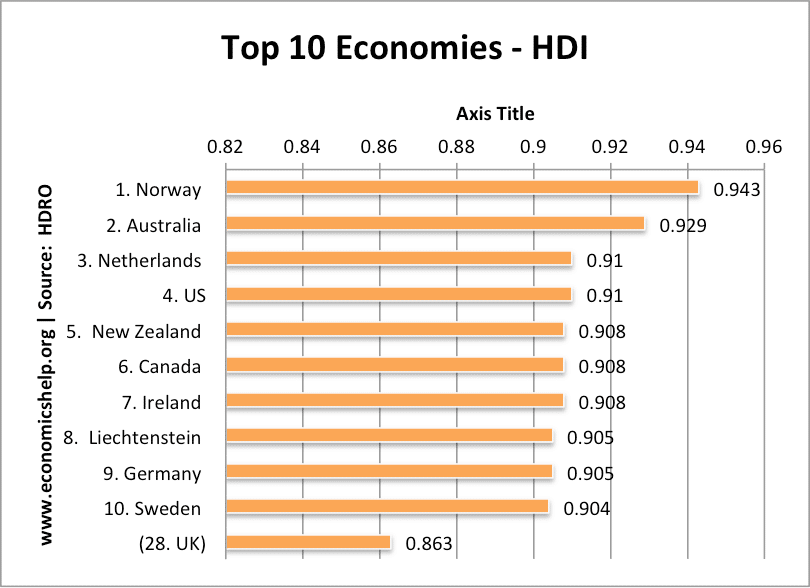
ReplyDeleteAs all the above mentioned I agree that the HDI should not determine the economic growth. Although the HDI has good factors such as life expectancy and so on we cannot just depend on that. After looking at the website attached to this blog I found it very informative as it showed the HDI of the countries year by year and their change. It keeps you informed and is very accurate. The chart at the top of this page is interesting to know where we as American stand. The HDI is good because it allows us as people to know the expectancy, education rates and our living. I think the HDI is great for our society but not to judge economic growth.
ReplyDeleteI believe that the HDI is just as important as the GDP in measuring the growth of a country. While the GDP is great for measuring the growth of the country it fails to correctly asses the welfare of the people living in the country. The HDI is a better at making that assessment, while it is not perfect it still does a much better job. It asses the life span, wealth, education, etc. I believe that both the GDP and the HDI should be used to asses the development of a country as only using one will not allow you make the proper judege meant of the country
ReplyDeleteIt is logical that economic growth is not the only measure by which the development of a country is assessed. You must take into account the people that make up that country. You must look at key dimensions of human development to fully judge the development of a country. These key dimensions are a long and healthy life, being knowledgeable, and having a decent standard of living. This is exactly what the Human Development Index (HDI) measures. A very good Human Development Index would be as close to 1 as possible. The country with the highest Human Development index is Norway at .944 and the United States comes in fifth place with a .914 Human Development Index. Although the HDI is a very good measure of the development of a country it is not flawless. The HDI does not take into consideration inequality, gender disparity, and human poverty. Because of these missing factors the HDI also cannot be the only way in which you measure a country’s development.
ReplyDeleteRiley Iafrate
I think that the HDI is an excellent way of measuring the growth of an economy and how well it is working. The HDI obtains more important information than the GDP, although I still believe the GDP should still be used, I just think the HDI should be taken into account a little more. The HDI measures life expectancy, knowledge, and having a decent standard of living, which all are important to an economy's ability to grow. The GDP is a great way of measuring growth as well, but the HDI is a great way to look at growth in a more micro aspect rather than the GDP's macro aspect.
ReplyDeleteI definetley agree that economic growth should not be the only thing to measure the growth of a country. And yes the people, and their capabilities should be counted, as well as education and life expectancy. But I wonder if we are missing somethings by calculating the economy this way. I know that new york, especially here in the hudson valley, money is tight. I can't imagine that our "economic growth" should not include the fact that wage are not matching the standard of living increases. So the measurements that are showing the economy is doing well, should look a little harder at details like standards of living and wage non increases. And i'm pretty positive that paying fast food workers $15 an hour is not going to help ANYONE!!!
ReplyDeleteWhile the HDI is a good base measurement to se the growth of countries. However what it lacks is what makes it not as credible since it doesn't take inequalities, poverty, and other social problems into the equation. The HDI is a more scoped in version of the GDP in some ways and gives a little more information about the people in the country opposed to it in general. Without social issues in the picture it is hard to say that this is an accurate measure of a nation but in a macro sense it definitely gives relevant information and lets us compare the growth of countries.
ReplyDeleteI believe the HDI is a great based measurement except every system has its flaws and bias around it. It is bias around the poverty and other economical issues in our society. The nation needs a close HDI that measures as close to 1 as it can get. The chart shows a great illustration on how the HDI proves witch countries have the best economical standing.
ReplyDeleteThis comment has been removed by the author.
ReplyDeleteI agree that economic growth should not be the only factor when measuring the development of a country. The HDI is an excellent way of measuring the growth of an economy and how well it is working. The HDI provides a good basis of the well being of a country's people. Since the HDI measures life expectancy, knowledge, and having a decent standard of living, which all are important to an economy's ability to grow. I think that The HDI obtains more important information than the GDP. Even though the GDP is a great way of measuring growth as well, but the HDI is a great way to look at growth in a more detailed aspect rather than the GDP's more overview aspect.
ReplyDeleteThere are many flaws to this HDI formula. One of the first flaws that I see from the article is the schooling category. This category has a cutoff mean of schooling of adults to 25 years. This cutoff is too low because there are many adults who go back to school in their late 20's and beyond who continue their schooling. So this category does not encapsulate all the people who are continuing their education. So my question is how will the HDI be affected if this information is being left off. Another flaw in HDI is that some people complete their schooling but after they receive their degree, there are some who end up never working. So with this information, wouldn't this skew the data for HDI, since a person would be included in the schooling category but not in the GNI. For example, there are two people same age who have completed identical bachelors and masters degrees where the first person takes his degree into the corporate world and the second doesn't work a day of their life. What would be the value of each individuals degrees? The second person who never worked a single day in their life doesn't contribute a dime into the GNI. Majority of the biggest oil producing countries have the liberties of funding their countries education and healthcare programs because of excess profits of their oil production go to fund all of these programs via their "sovereign wealth funds". Countries with a bigger population, like the United States are at a bigger disadvantage then those with small populations, like Norway. The United States with a population of 320 million does not have the advantage of providing their citizens with the identical social programs as Norway. Norway has a smaller population of around 5 million people so they are able to provide all their social programs using excess profits from their oil. So overall, knowing that population is not a component of the HDI, if Norway had a population of 320 million and the U.S. had a population of 5 million, what would be the end result of the 3 key dimensions:" a long and healthy life, being knowledgeable and have a decent standard of living"?
ReplyDeleteNicholas Swyntuch
HDI does not provide a great measurement to economic activity but it does help understand which countries are developing better then others. The key factors that are left out of the HDI include inequality, poverty, and human security. Take for example Cuba, who has a HDI rating as high as 44. The well being of their country seems to be fairly high when compared to the world, but their economic activity is very low. The GDP of Cuba in 2011 was $68 Billion which is very low. The GDP may not also be the best measurement but it does point out serious flaws in the HDI system
ReplyDeleteThe HDI like any measurement has its flaws, if you had 10 million people who have nothing and 10 million people who are rich beyond imagination their HDI might look quite good even though the overall living of the country is awful. Another error is the lack of the scope of data for some both schooling and Gross national income. Some people continue schooling for a doctorate and end at 26 or later and some take a couple years break and finish school in their late 20's. Both of these sets of people aren't counted as it measures education AT 25 and not after. Also, some countries have a larger percent of housewives and their "value" to society isn't measured by the HDI, because of all these oversights the HDI ends up being skewed to certain countries, such as richer countries. However, for the most part the HDI supplies a good baseline as long as you take its data with a grain of salt.
ReplyDeleteChristopher Carapola
The HDI was made to assess the development of the country. It has it's flaws like, not reflecting inequalities and poverty. The HDI doesn't cover these things so the data won't always be 100% accurate. However, HDI is just as good, if not better than the GDP. GDP is a good way to measure growth, but it is more of a broad aspect. The HDI is more in depth and focuses more of a micro aspect. Both aren't perfect but they are still effective.
ReplyDelete